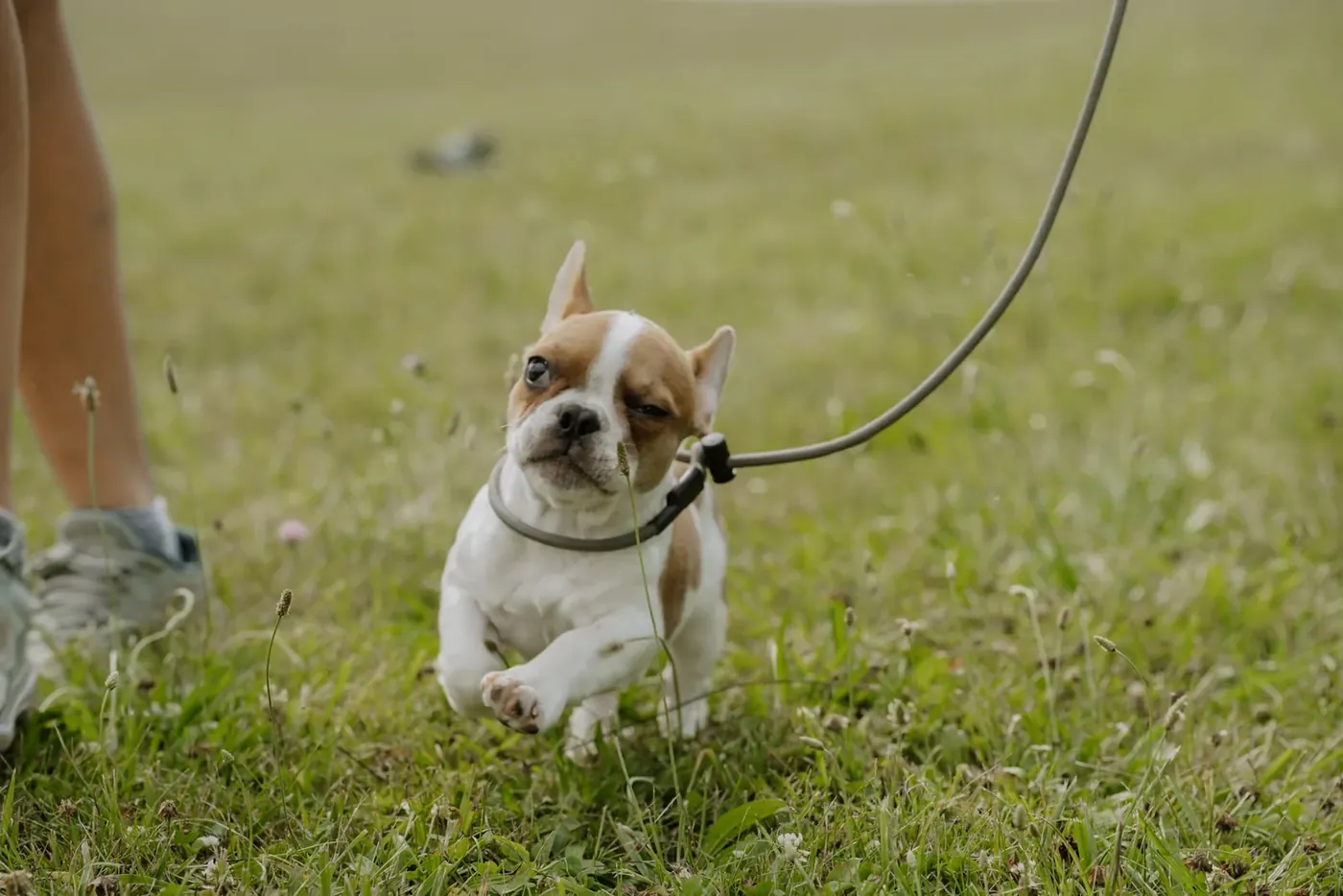
Leash pulling is the number one reason people call a dog trainer, and it is also the problem most often explained wrongly.
Your dog is not pulling to be dominant. Your dog is not pulling because it does not respect you. Your dog is pulling because for every day of its life, pulling has produced forward motion toward interesting things, and you have been the engine that made it work.
The mechanics nobody mentions
Dogs have an opposition reflex. Push into a dog and it pushes back. Pull on a dog and it pulls against you. This is wired in, not learned, and it is why tightening the leash when your dog is already pulling makes the pulling worse in the moment.
Layer on top of that: dogs walk at about four miles an hour, we walk at about two and a half. Even a dog with no behavioral issue at all is going to drift ahead of you, and then the leash tightens, and then the reflex kicks in, and then forward motion happens anyway. Pulling just got paid, again.
So the fix is not about strength and it is not about equipment. It is about changing what pulling produces.
The one rule that does the work
A tight leash means the walk stops. A loose leash means the walk continues.
That is the entire system. Everything else is the detail of how you deliver it.
Hold the leash in a fixed position, hand at your hip, not floating out in front of you. The instant the leash goes tight, you stop moving. Not a correction, not a word, just a statue. The moment there is slack, even half a second of it, you move again.
For the first week, expect to cover about two blocks in twenty minutes. This feels ridiculous. Do it anyway. The dog is learning something it has never had reason to learn: that you are not a tow truck.
What to add once that is working
Once your dog can hold slack for thirty seconds at a time, add these:
- Change direction often. Walk ten steps, turn, walk ten steps, turn. A dog that has to pay attention to where you are going cannot be ahead of you planning its own route.
- Pay the position, not the stop. Most people only reward after a correction. Reward while the dog is walking correctly, next to you, with nothing going wrong. That is the picture you want more of.
- Train in a boring place first. Your driveway, then your street, then a quiet park, then a busy one. Dogs do not generalize well. A dog that walks beautifully in the kitchen genuinely does not know what you want at the pet store.
- Use the dog's meals. A dog that works for its dinner on a walk is more motivated than a dog that has already eaten and is being offered a biscuit.
About equipment
Tools manage pulling. They do not teach a dog not to pull. That distinction matters because a lot of owners buy a no-pull harness, get immediate relief, stop training entirely, and then find themselves back at square one when the harness comes off.
A front-clip harness or a head halter is a reasonable bridge while the training is happening. A flat collar with real handling skill is the destination. Which tool a particular dog starts on depends on the dog's size, strength and history, and it is one of the first things a trainer will assess in person rather than over the internet.
Equipment buys you control today. Training buys you a dog that does not need the equipment.
When pulling is not really pulling
There is a version of this that looks like pulling and is not: the dog that lunges, fixates, and cannot be redirected when it sees another dog, a bike or a jogger. That dog is not practicing a habit, it is having an emotional response, and the stop-and-go method will not touch it.
If your dog's leash problems happen specifically around triggers, with barking, hackles up, or an inability to eat a treat it would normally love, you are dealing with leash reactivity, and the plan is different.
How long it should take
For an average adult dog with a long pulling history and an owner who practices daily: two to four weeks for reliable loose-leash walking in low-distraction environments, longer to hold up on a busy sidewalk.
For owners whose schedule makes daily practice unrealistic, a board and train compresses that into focused daily reps with a professional, and the handoff sessions at the end teach you the leash mechanics directly. Find a K9aholics trainer near you if you would rather be handed the skill than reverse-engineer it.